


Understanding Short Selling and Its Risks
How Short Selling Works (and Why It’s Not Intuitive)
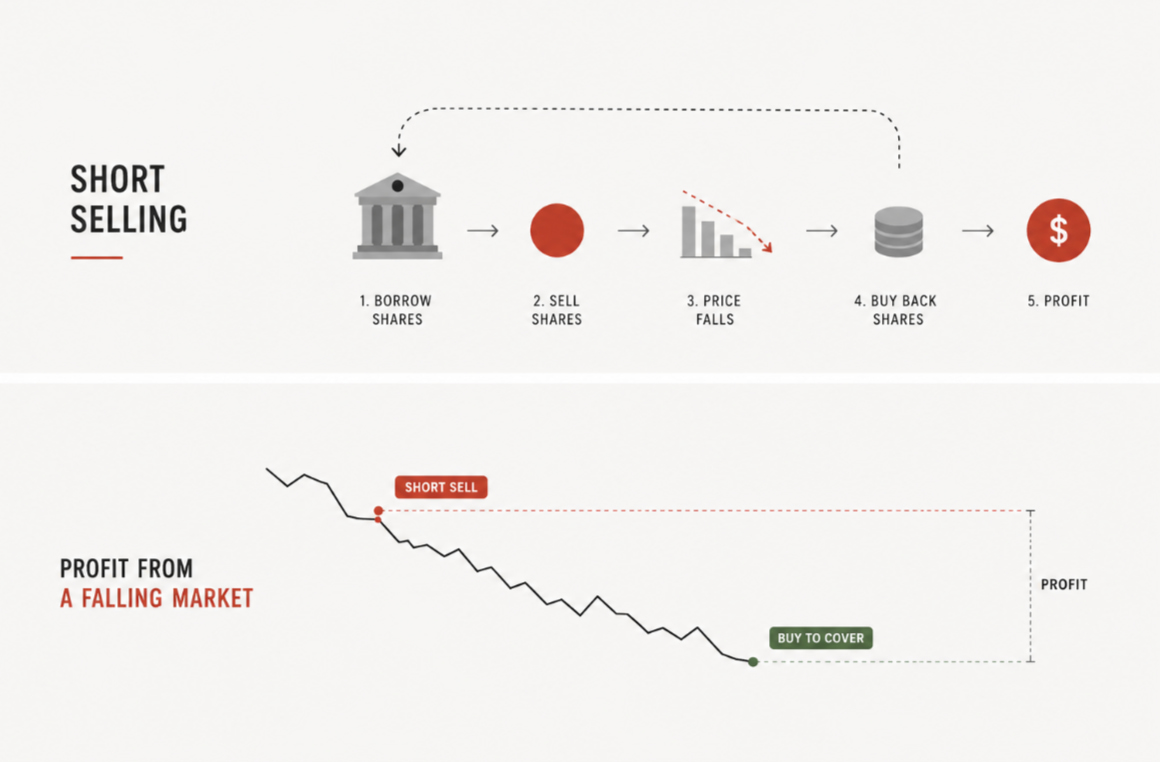
To understand short selling, you need to step away from the usual “buy first, sell later” logic. With short selling, the process is reversed: you sell first, and buy later.
Here’s how it works: You borrow shares from a broker (on the Fondexx platform, borrow rates start from just 0.0006$ per share), sell them immediately at the current market price, and hope the price will drop. If it does, you buy the same shares back at a lower price, return them to the broker, and keep the difference as profit. For example, if you short a stock at $100 and it falls to $70, you make $30 per share.
On paper, this may seem straightforward. But here’s the key difference from traditional investing: when you buy a stock, your maximum loss is limited to the amount you invested. With short selling, however, your position moves against you if the price rises - and that fundamentally changes the level of risk.
Why Investors Use Short Selling
Despite its complexity, short selling is widely used - and not just for speculation.
Profiting from declines - Markets don’t only go up. There are downturns, corrections, and overvalued companies. In these situations, short selling allows investors to benefit from falling prices.
Identifying overvalued assets - Some investors specialize in finding overpriced companies. They analyze financial statements, business models, and market behavior to identify assets whose price, in their view, doesn’t reflect their true value.
Even in these cases, short selling is not a “simple tool” - it’s more of a professional approach that requires experience and a clear strategy.
Key Risks That Are Often Underestimated
The risks are what make short selling especially challenging - particularly for beginners. When you buy a stock, the worst-case scenario is that it drops to zero. But with short selling, there is theoretically no limit to how high a price can go. A stock can double, triple, or more - and each increase means greater losses for you.
A short squeeze happens when a stock’s price rises sharply, forcing investors with short positions to close them. To do that, they must buy shares, which increases demand and pushes the price even higher. This can lead to rapid and uncontrollable price spikes. A well-known example is GameStop in 2021, when the price surged dramatically in a short period, causing significant losses for those betting against it, and a recent short squeeze in $CAR stock triggered by a hedge fund that bought massive call options on the stock.
Short selling typically involves borrowed funds. If the price moves against you, your broker may require additional collateral. If you can’t provide it, your position may be closed automatically - often at the worst possible time.
There are also less obvious costs:
Trading fees
Borrowing costs for shares
Dividend payments (you may have to compensate the original owner if dividends are paid and this rule applies to swing positions)
Over the long term, markets tend to rise. This means short selling goes against the general trend, which makes it inherently more difficult.
What to Understand Before Using Short Selling
In theory, short selling can seem attractive - it looks like a way to profit in any market condition. But in practice, it requires much more control than traditional investing.
Timing is critical - With long-term investing, time is usually on your side. With short selling, it often works against you. An asset can stay overvalued much longer than you expect.
Psychological pressure - Watching losses grow as prices rise is much harder than holding an asset that temporarily declines. The emotional pressure is significantly higher.
Risk management is essential - Short selling requires a clear risk management strategy. Without it, even one bad position can have a serious impact on your portfolio. And always remember that any short position is always a margin position and that the stock price potentially can grow infinitely.
For most investors, especially beginners, short selling is not a core strategy. It’s usually more effective to first build a solid understanding of the market, learn how to manage risk, and only then consider more advanced tools.

Conclusion
Short selling is one of the most interesting tools in financial markets. It offers the opportunity to profit not only from growth, but also from decline. However, this opportunity comes with a higher level of risk.
Its key feature is asymmetry: potential profits are limited, while losses can grow without a clear upper limit. This is what makes short selling far more complex than it may seem at first.
The main takeaway is not that short selling is “bad” or unnecessary. Rather, it’s a tool that requires understanding, experience, and discipline. As in most areas of investing, success depends not on the tool itself, but on how it is used.