


What is Quantitative Easing and How Does it Work?
If you've ever followed financial news during a recession or a period of economic uncertainty, you've probably heard central banks announce a new round of Quantitative Easing, often shortened to QE.
For many people, it sounds like one of the most complicated concepts in economics. Headlines frequently describe it as "printing money," while analysts debate whether it stimulates growth or fuels inflation. But what does Quantitative Easing actually mean, and why does it have such a significant impact on financial markets?
The reality is that QE isn't just an economic buzzword - it has shaped some of the biggest market rallies of the last two decades. Following the 2008 global financial crisis and again during the COVID-19 pandemic, central banks around the world used Quantitative Easing to stabilize economies, support financial markets, and encourage lending.
Understanding how QE works helps investors make better sense of why stock markets sometimes continue rising even during periods of economic weakness, why interest rates matter so much, and why central bank decisions often move markets around the world.
In this article, we'll explain what Quantitative Easing is, why central banks use it, how it works behind the scenes, how it affects stocks, bonds, and inflation, and what every investor should understand before reacting to headlines about monetary policy.
What Is Quantitative Easing (QE)?
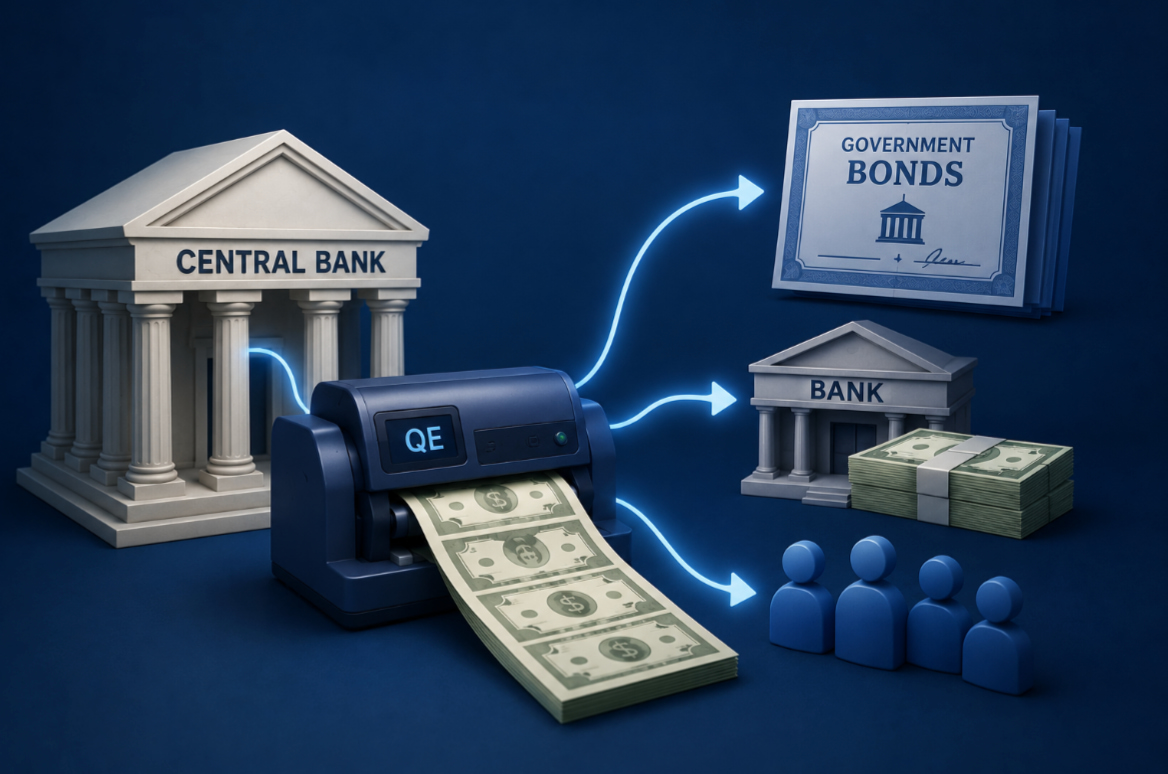
Quantitative Easing is a monetary policy tool used by central banks to increase the amount of money circulating in the financial system and stimulate economic activity. Unlike traditional monetary policy - which mainly relies on changing short-term interest rates - QE is typically used when interest rates have already been reduced to very low levels and central banks need additional ways to support the economy.
Instead of simply lowering interest rates, the central bank purchases large quantities of financial assets, primarily government bonds, from commercial banks and other financial institutions.
When the central bank buys these assets, it pays for them by creating new central bank reserves electronically.
This process increases liquidity in the financial system, giving banks more capital available for lending and investment.
It's important to understand that QE does not literally mean trucks full of newly printed cash entering the economy. In modern financial systems, most of this "new money" exists electronically within the banking system.
The objective is simple:
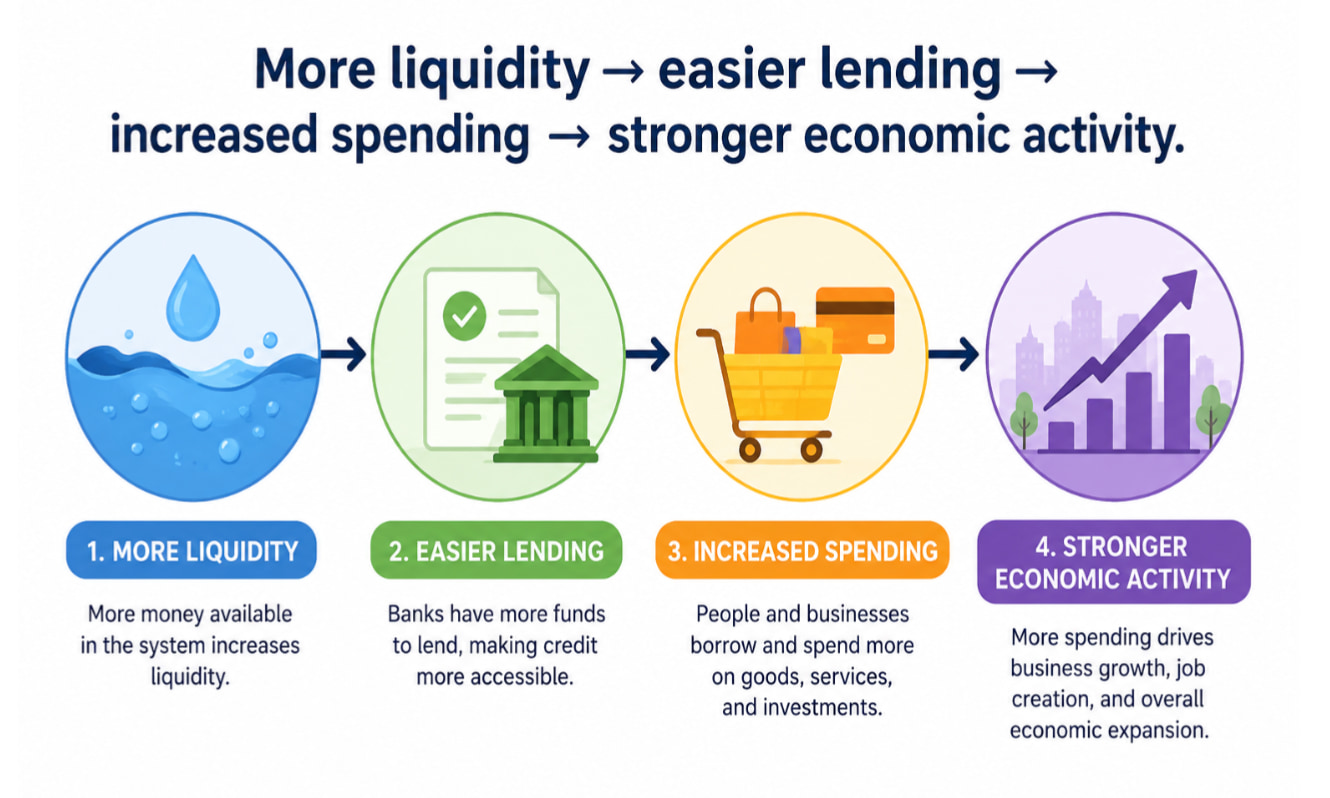
At least, that's how the theory works.
Why Do Central Banks Use Quantitative Easing?
Central banks typically introduce QE during periods of severe economic stress. These situations often include:
financial crises
recessions
banking instability
very low inflation
weak consumer spending
rising unemployment
Under normal conditions, central banks influence the economy by adjusting benchmark interest rates. Lower rates encourage borrowing. Higher rates slow borrowing. However, once interest rates approach zero, central banks have fewer conventional tools available. This is where Quantitative Easing becomes important.
By purchasing massive amounts of government bonds and other securities, central banks inject additional liquidity into financial markets, hoping to encourage banks, businesses, and consumers to spend and invest more confidently. Major examples include the 2008 Global Financial Crisis, the COVID-19 pandemic in 2020, and periods of prolonged low inflation in Japan.
Each episode demonstrated how QE can become one of the primary policy tools when traditional measures are no longer sufficient.
How Quantitative Easing Actually Works
Although the concept sounds technical, the basic mechanism is surprisingly straightforward. Imagine a commercial bank owns a large amount of government bonds. The central bank decides to purchase those bonds. Instead of paying with physical money, it credits the bank's reserve account electronically. Now two things happen simultaneously:
First, the commercial bank has more liquidity available.
Second, the central bank now owns more government bonds.
Because banks suddenly have larger reserves, they are theoretically more willing to lend money to businesses and households. Lower borrowing costs can stimulate business investment, mortgage lending, consumer spending, hiring and economic growth.
At the same time, increased demand for government bonds pushes bond prices higher and yields lower. Lower bond yields often encourage investors to move money into other assets like corporate bonds, real estate, or stocks in search of better returns.
This is one reason stock markets often perform well during periods of aggressive Quantitative Easing.

How QE Affects the Economy and Financial Markets
Quantitative Easing influences far more than just banks. It affects the entire financial system.
Lower Interest Rates
As central banks purchase bonds, bond yields generally decline. Lower yields make borrowing cheaper for governments, companies, and consumers. This can stimulate investment and economic activity.
Higher Stock Prices
When bond yields become less attractive, investors often shift part of their portfolios toward equities. Increased demand for stocks may contribute to higher market valuations. This doesn't necessarily mean companies become instantly more profitable. Instead, investors begin valuing future earnings more highly because alternative investments generate lower returns.
Rising Asset Prices
QE often affects more than equities. Real estate, corporate bonds, infrastructure investments, and other financial assets may also appreciate as liquidity increases. This explains why many financial assets experienced strong gains during years of aggressive monetary stimulus.
Inflation Expectations
One goal of QE is to encourage moderate inflation. When consumers and businesses expect prices to rise gradually, they may become more willing to spend and invest rather than delay purchases. However, if excessive liquidity remains in the system for too long, inflation can accelerate beyond policymakers' targets. This became a major topic following the COVID-19 pandemic.
The Benefits and Risks of Quantitative Easing
Like any economic policy, QE has both advantages and drawbacks. Supporters argue that Quantitative Easing helps prevent deeper recessions by stabilizing financial markets and restoring confidence. During periods of crisis, liquidity can prevent credit markets from freezing and reduce the risk of widespread financial instability. QE has also helped lower borrowing costs, support employment, and encourage investment during periods of economic weakness.
However, critics point to several important risks. One concern is inflation. If too much money enters the economy while production remains limited, prices may rise faster than expected.
Another concern is asset bubbles. Easy money can encourage excessive investment in stocks, cryptocurrencies, or real estate, pushing prices above their fundamental value. Some economists also argue that QE may increase wealth inequality because rising financial asset prices primarily benefit those who already own investments. Finally, there is the challenge of reversing QE. Once central banks begin reducing their balance sheets - a process known as Quantitative Tightening (QT) - markets may experience increased volatility as liquidity declines.
What Investors Can Learn from Quantitative Easing
For investors, Quantitative Easing offers an important lesson about how monetary policy influences financial markets. Many beginners focus exclusively on company earnings or economic data. Experienced investors also pay close attention to central bank policy because liquidity often shapes market conditions.
Understanding QE helps explain why:
markets sometimes rise during recessions
interest rate announcements move stock prices
bond yields matter for equity valuations
central bank meetings receive enormous market attention
That doesn't mean investors should attempt to predict every policy decision. Instead, understanding the broader relationship between liquidity and financial markets provides useful context when evaluating long-term investment opportunities.
Perhaps the biggest lesson is this:
Markets are influenced not only by company performance but also by the financial environment in which those companies operate.
Conclusion
Quantitative Easing is one of the most influential monetary policy tools used by modern central banks. While the mechanics may appear complex, the underlying goal is relatively straightforward: increase liquidity, support lending, encourage investment, and stabilize the economy during periods of financial stress.
For investors, understanding QE isn't about becoming an economist. It's about recognizing how central bank decisions influence interest rates, market sentiment, asset prices, and long-term investment performance.
Because in today's financial markets, monetary policy often plays just as important role as corporate earnings. Furthermore, the more investors understand these broader economic forces, the better equipped they are to make informed, long-term investment decisions rather than reacting to headlines alone.