


Arbitrage in Trading
Many newcomers to trading are drawn to the idea of earning profits with minimal market risk - a concept often linked to arbitrage.
Arbitrage may seem simple at first: buy an asset where it’s cheaper, sell it where it’s more expensive, and pocket the difference. There’s no need to predict market direction or guess price movements. But in reality, arbitrage is much more complex beneath the surface.
Today, arbitrage remains one of the most important concepts in financial markets - not only because some investors use it as a strategy, but because it helps explain how markets become more efficient.

What Is Arbitrage in Trading?
At its core, arbitrage is about taking advantage of price differences for the same asset in different places - whether that’s between markets, exchanges, or financial products. The idea is simple: buy something where it’s cheap and immediately sell it where it’s more expensive. If you pull this off, the price gap becomes your profit.
While this seems clear-cut in theory, such opportunities are rare and fleeting in today’s fast-moving markets.
How Arbitrage Actually Works
The reason arbitrage exists at all is that markets are not perfectly synchronized. Prices move constantly, liquidity changes, and different participants react at different speeds.
Back in the day, you could spot arbitrage just because news and prices took a while to make their way around. Now, things are a whole lot quicker. Major trading firms have tech that catches even the smallest price differences in a flash and acts on them right away.
So, it’s all about being quick. The trick isn’t just noticing when prices are off, but jumping on it before the opportunity disappears. Still, the essence of arbitrage hasn’t changed: every now and then, the market slips up for a moment, and the fastest traders grab the advantage.
Arbitrage doesn’t just offer ways to profit - it also plays a role in keeping markets efficient. When traders buy undervalued assets and sell overvalued ones, prices tend to converge.
Types of Arbitrage Strategies
While the basic idea remains the same, arbitrage can take several forms depending on the market.
One of the most common examples is exchange arbitrage. This occurs when the same asset trades at different prices across different platforms or exchanges, such as Bitcoin on different cryptocurrency exchanges.
Another approach is statistical arbitrage, in which traders use mathematical models and historical relationships between assets to identify temporary pricing imbalances. A common example is the relationship between the GLD and GDX ETFs.
There is also triangular arbitrage, often associated with currency markets. In this case, traders exploit inconsistencies between exchange rates. If exchange rates become temporarily misaligned, a small profit opportunity may arise.
For example, in currency markets, a trader might exchange Currency A for Currency B, then Currency B for Currency C, and finally swap Currency C back to Currency A - profiting if the exchange rates are misaligned.
There’s also merger arbitrage, where traders focus on companies involved in mergers or acquisitions. They try to make money by betting on the difference between a company’s current stock price and its value if the deal goes through.
Each of these arbitrage strategies comes with its own level of complexity, speed, and risk.
Why Arbitrage Is Not “Easy Money”
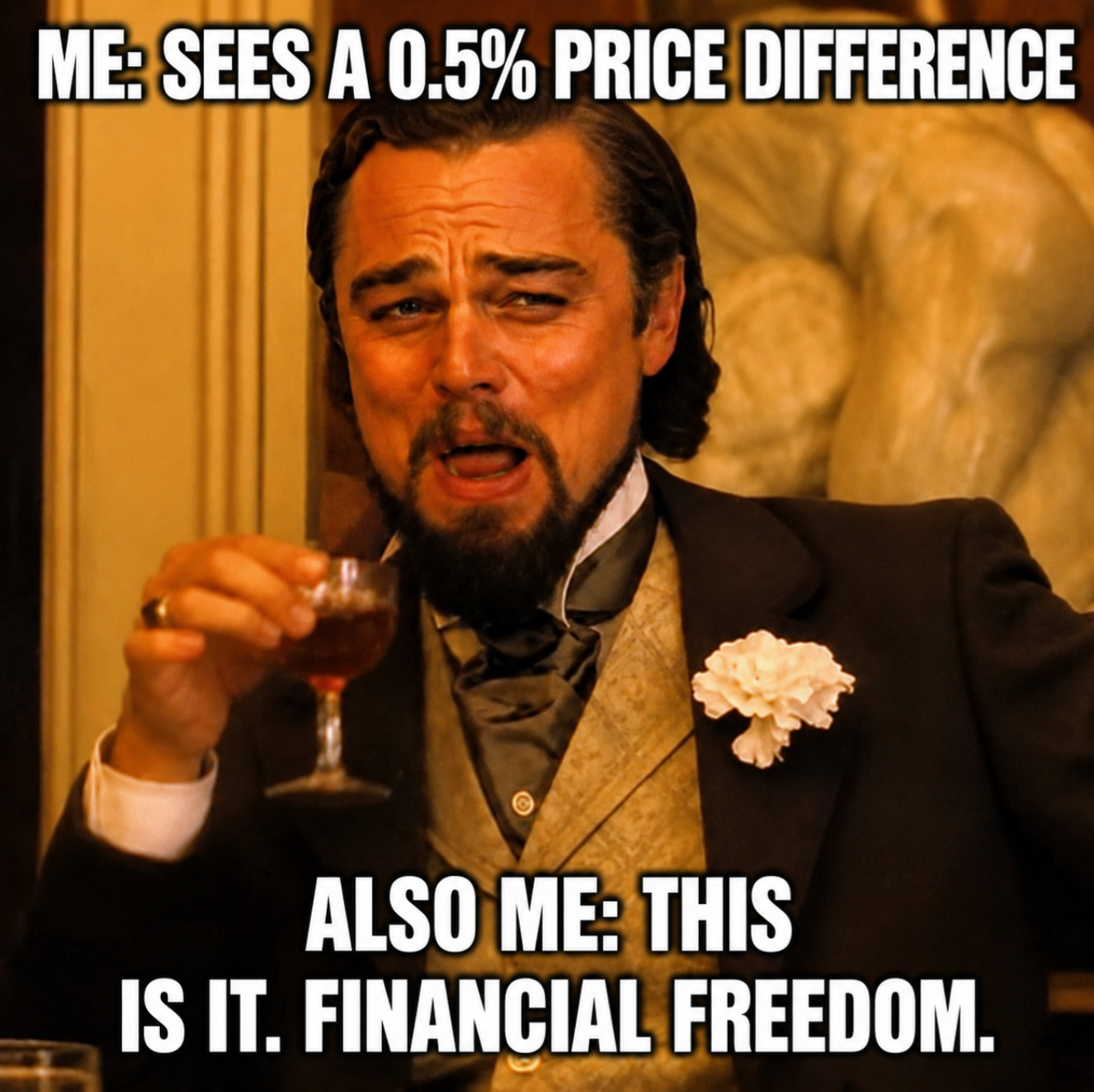
A common misconception is that arbitrage guarantees risk-free profits. In practice, almost all arbitrage strategies come with real-world complications, and truly risk-free opportunities are extremely rare.
First, there are transaction costs - commissions, spreads, taxes, and execution costs, which can quickly eat up even a small price difference.
Second, there is execution risk. You may successfully buy an asset but fail to sell it at the expected price.
Third, there is liquidity risk. Even if you manage to purchase an asset on one exchange, this does not guarantee that there will be sufficient liquidity on another exchange to sell it at the desired price. As a result, the trade may be executed only partially or at a less favorable price.
Fourth, there is time risk. Arbitrage opportunities often disappear within seconds.
Finally, there is competition. Large financial institutions invest significant resources in technology, infrastructure, and algorithms to identify and capitalize on arbitrage opportunities faster than other market participants.
That's why many trades that look profitable on paper are much harder to pull off in the real world.
Dangers and Constraints Investors Often Ignore
Because arbitrage sounds logical and controlled, many novices underestimate the risks. One important factor is the liquidity risk. Even if price differences exist, there may not be enough buyers or sellers available at these prices.
A further challenge is the market friction. Moving capital between exchanges, settlement delays, currency conversion, and regulation can affect execution.
Technology also matters. Institutional traders generally operate with infrastructure measured in milliseconds - something retail investors usually are unable to replicate.
Most importantly, some situations that look like arbitrage are actually rewards for taking on hidden risks. Obvious profit chances rarely last. So, understanding where the real risk lies is crucial.
What Arbitrage Can Teach Investors
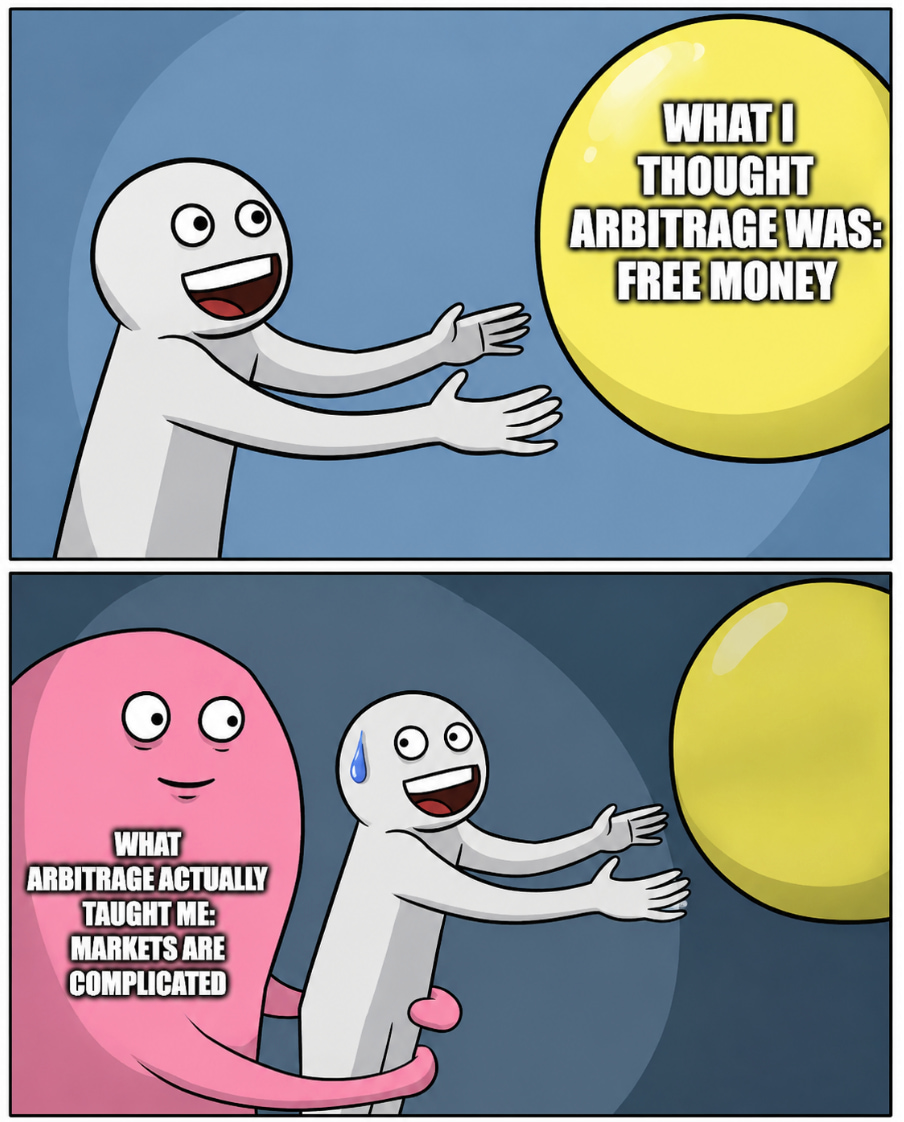
You don’t have to trade arbitrage to learn something valuable from it. Just knowing how markets work can shift your perspective on how they really operate. Arbitrage is evidence that prices aren’t always spot-on; markets are constantly shifting due to factors such as information flow, liquidity, investor behavior, technological advances, and people’s expectations.
It’s a good reality check: what sounds simple can get pretty complicated in the real world. And for anyone investing for the long haul, it’s a reminder that some opportunities are harder to take advantage of than they first appear, and just because prices are different doesn’t mean there’s real value to be found. Often, patience, a well-structured approach, and long-term discipline work better than chasing small market gaps.
Conclusion
Arbitrage is a fascinating part of trading because it brings together math, technology, and market behavior. The basic idea is simple - buy low, sell high - but in practice, finding free profit is rare.
It’s about identifying inefficiencies, understanding execution, and managing risks that aren't always apparent at first glance. For beginners in particular, arbitrage is less important as a strategy and more valuable as a way to understand how markets function.
Financial markets aren’t just about guessing where prices will go - they’re also about understanding the reasons behind those movements.