


The Basics of Bond Investing: The “Boring” Asset That Deserves More Attention
Stocks usually get the attention. They produce the dramatic headlines, the impressive rallies, the sudden crashes, and the stories about companies that turned early investors into millionaires. Bonds rarely generate the same excitement. And that's exactly why many beginner investors underestimate them.
Behind their relatively quiet reputation is an enormous global market used by governments, corporations, pension funds, banks, and individual investors. Bonds can generate income, help reduce portfolio volatility, preserve capital, and provide diversification when stock markets become unpredictable. However, bonds aren't simply “safe stocks.”
They work differently, react differently to interest rates, and carry risks that aren't always obvious at first glance. Once you understand those mechanics, however, bond investing becomes surprisingly intuitive.
What Is a Bond, Really?
The easiest way to understand a bond is to forget financial terminology for a moment. Imagine a company wants to build a new factory. It needs $500 million. There are several ways it could raise that money. It could use existing cash, borrow from a bank, issue additional shares, or borrow directly from investors.
That last option is where bonds come in. When you purchase a bond, you are essentially lending money to the bond issuer. The issuer could be a government, municipality, corporation, or another organization. In exchange for your money, the issuer promises to repay you according to predetermined terms. Those terms typically include two important things:
Interest payments - compensation for lending your money.
Principal repayment - the return of the bond's face value when it reaches maturity.
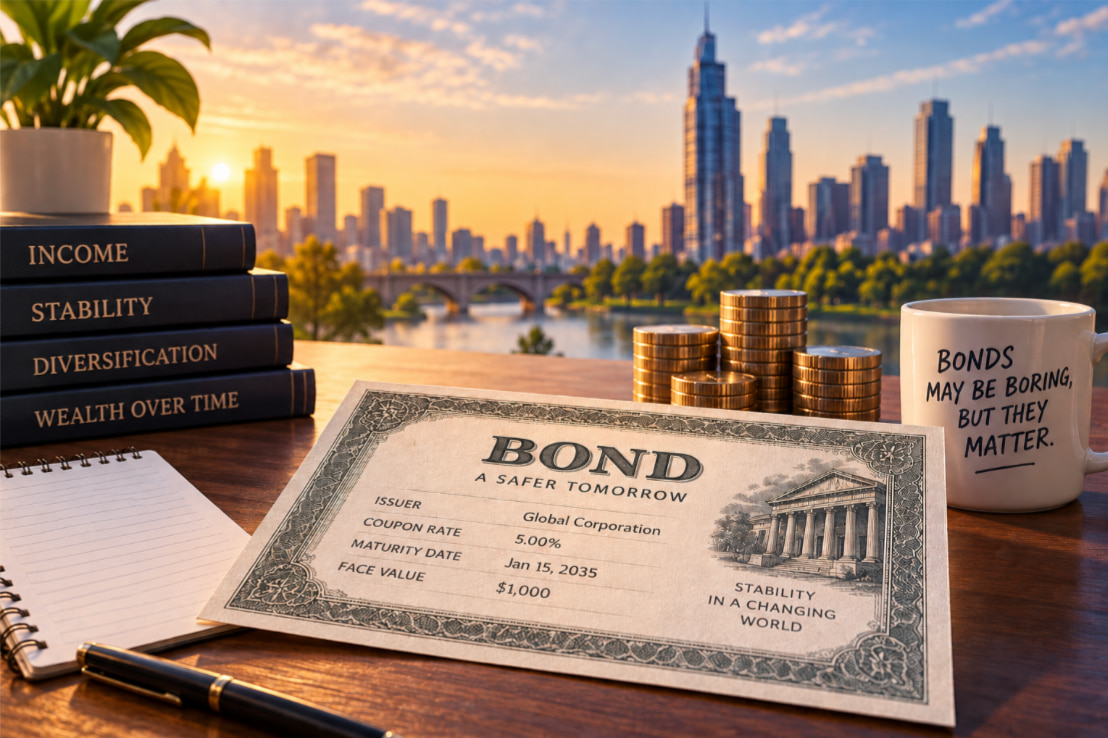
Suppose a company issues a $1,000 bond with a 5% annual coupon and a maturity of 10 years. You purchase the bond for $1,000. The company pays you $50 per year in interest, assuming a conventional annual coupon structure, and at the end of the 10 years it returns the $1,000 principal, provided it remains able to meet its obligations.
In simplified form:
You lend $1,000 - receive interest - eventually receive your $1,000 back.
That's the basic idea behind most traditional bonds. However, there's an important difference between buying bonds and buying stocks. When you purchase stock, you become a partial owner of the company. When you purchase a bond, you become a creditor.
You don't participate directly in the company's unlimited upside. If its profits suddenly triple, your bond doesn't necessarily become three times more valuable. Instead, you're primarily interested in whether the issuer can continue making the promised payments. That distinction explains much of the difference between stock and bond investing.
How Do Investors Make Money From Bonds?
At first glance, bond returns seem straightforward: you collect interest. In reality, there are several ways bond investors can potentially generate returns.
Coupon Payments
The most obvious source is the coupon. A bond's coupon rate determines the interest payments the issuer agrees to make.
For example, a $1,000 bond with a 4% coupon would generally pay $40 per year, although the exact payment schedule depends on the bond's terms.
For income-focused investors, these predictable payments can be attractive. However, the coupon rate isn't necessarily the same as the return you'll actually earn. Why? Because bonds can trade above or below their original face value.
Price Changes
Many bonds can be bought and sold in the secondary market before maturity. This means their prices fluctuate. Suppose you purchase a bond for $1,000 and later sell it for $1,050. In addition to any interest payments you've received, you've generated a $50 capital gain.
The reverse can also happen. If you need to sell when the bond trades at $900, you may realize a loss even if the issuer hasn't missed a single interest payment. This is one of the first important lessons for beginners: Bonds can lose value even when the issuer continues paying exactly as promised.
Yield
This brings us to one of the most important terms in bond investing: yield. Yield attempts to describe the return an investor receives relative to the bond's current price. Imagine an existing bond pays $50 per year. If you buy it for $1,000, that $50 represents 5% of the purchase price. However, if its market price falls to $900, the same $50 payment becomes more attractive relative to the lower purchase price. This relationship between price and yield sits at the heart of bond investing. And it becomes especially important when interest rates change.

Why Bond Prices Move When Interest Rates Change
If there's one bond concept every beginner should understand, it's this: Bond prices and market interest rates generally move in opposite directions.
Rates rise → existing bond prices generally fall.
Rates fall → existing bond prices generally rise.
Why? Consider a simple example. You own a bond paying 3%. Then interest rates rise, and newly issued comparable bonds begin paying 5%. If another investor can buy a new bond yielding 5%, why would they pay full price for yours at 3%? They probably wouldn't. To become competitive, the market price of your existing bond generally needs to fall.
Now reverse the situation. Suppose you own a bond paying 5%, but newly issued comparable bonds offer only 3%. Your 5% bond suddenly looks much more attractive. Investors may therefore be willing to pay a premium for it. This is why bond markets pay such close attention to central banks and interest rates. Changes in monetary policy can significantly affect the value of existing bonds even when the issuer's financial condition hasn't changed.
Why Maturity Matters
Not every bond reacts equally to changing interest rates. Generally, longer-term bonds are more sensitive to interest-rate movements than shorter-term bonds, all else equal. Imagine locking in a 3% rate for two years versus 30 years.
If market rates suddenly rise to 5%, being stuck with the lower rate for 30 years is much more significant than being stuck with it for only two. This sensitivity is closely related to a concept called duration. You don't need to master duration calculations to start investing in bonds, but understanding the basic principle is useful: The longer your exposure to fixed payments, the more interest-rate changes can matter.
Government vs. Corporate Bonds: Understanding the Choices
Saying “I invest in bonds” is a little like saying “I invest in stocks.” It doesn't tell us very much. The bond market contains many different instruments with dramatically different levels of risk and potential return.
Government Bonds
Governments issue bonds to finance public spending and refinance existing debt. In the United States, these securities include Treasury bills, notes, and bonds with different maturities. U.S. Treasury securities are generally considered to carry very low credit risk because they're backed by the U.S. government.
That doesn't mean their prices can't fall. Long-term government bonds, for example, can experience substantial price declines when interest rates rise. This distinction matters: Low credit risk does not mean zero market risk.
Corporate Bonds
Companies issue bonds to finance expansion, acquisitions, infrastructure, or other business activities. Because companies can default, corporate bonds generally need to offer investors higher yields than comparable government debt. But not all corporate bonds carry the same risk.
A financially strong multinational corporation and a heavily indebted speculative company may both issue bonds, but investors will demand very different returns from each. This is where credit ratings become useful. Major rating agencies evaluate issuers and assign ratings designed to reflect their creditworthiness. Higher-rated bonds are commonly referred to as investment grade, while lower-rated securities are often called high-yield bonds.
You've probably also heard the less flattering term “junk bonds.” The higher yields can look attractive, but they're higher for a reason. Investors are being compensated for accepting greater credit risk.
Municipal Bonds
Municipal bonds are issued by states, cities, and other local government entities, particularly in the United States. They may be used to finance infrastructure such as roads, schools, hospitals, or public utilities.
Certain municipal bonds can offer tax advantages to eligible U.S. investors, making them particularly relevant for some higher-income portfolios. As always, however, tax treatment depends on the investor and the specific security.
How Beginners Can Approach Bond Investing
Beginners don't necessarily need to research hundreds of individual bonds. There are two broad ways to gain bond exposure: individual bonds and bond funds or ETFs. Individual bonds can provide more certainty about maturity dates and scheduled payments, assuming the issuer doesn't default. However, building a properly diversified portfolio of individual bonds can require more capital and research.
Bond ETFs and funds provide another approach. A single fund may hold hundreds or thousands of bonds across multiple issuers and maturities, making diversification significantly easier. But bond funds don't work exactly like individual bonds.
An individual bond generally has a defined maturity date when principal is scheduled to be repaid. A conventional bond fund continuously buys and sells securities and therefore doesn't necessarily provide the same fixed maturity experience. Neither option is automatically better. They simply solve different problems.
The Risks of Bond Investing
One of the most persistent misconceptions about bonds is that they're automatically “safe.” They can be less volatile than many stocks, depending on the type of bond, but lower risk doesn't mean no risk. And different bonds carry very different risks.
Credit Risk
The most obvious question is: Will the issuer actually repay you? Governments with strong finances may present relatively low default risk, while financially unstable companies may carry substantially more.
If an issuer defaults, bondholders can lose some or potentially much of their investment. This is why higher yields should never be viewed as free money. When a bond offers dramatically more than comparable securities, the market is often telling you something about perceived risk.
Interest-Rate Risk
As we discussed earlier, rising interest rates can reduce the market value of existing fixed-rate bonds. This matters particularly if you need to sell before maturity. If you can hold an individual bond until maturity and the issuer fulfills its obligations, short-term price fluctuations may be less important. However, investors in bond funds or those who need liquidity should pay close attention to interest-rate sensitivity.
Inflation Risk
Suppose your bond earns 3% per year while inflation is running at 5%. Your account may still be receiving interest, but your purchasing power is declining in real terms. This makes inflation particularly important for long-term fixed-income investors. A predictable nominal return isn't necessarily a strong real return after inflation.
Liquidity Risk
Some bonds trade frequently. Others don't. If you own a less liquid bond and need to sell quickly, you may struggle to find a buyer at the price you expect.
Reinvestment Risk
There's another risk that becomes particularly relevant when interest rates fall. Suppose a bond matures and returns your principal, or makes a coupon payment, but new bonds now offer significantly lower yields. You have your money back, but you may not be able to reinvest it at the same attractive rate. This is known as reinvestment risk. Bonds may look simple, but as these examples show, their risk comes in several different forms.
Conclusion
Bonds may never generate the same excitement as the hottest technology stock. That's probably fine. Their purpose in a portfolio is often very different. Bond investing is fundamentally about lending capital in exchange for an expected return. But beneath that simple idea is a market shaped by interest rates, inflation, credit quality, maturity, and investor expectations.
Understanding these mechanics helps eliminate one of the biggest investing myths: that bonds are simply the “safe” part of a portfolio. Some bonds are relatively conservative. Others carry substantial risk. The important question isn't whether bonds are good or bad. It's whether a particular bond investment serves a useful purpose within your financial strategy.
For a younger investor with decades ahead, that role may be relatively small. For someone approaching retirement, seeking income, or protecting money needed in the near future, bonds may become much more important. And that's perhaps the most useful way to think about them. Stocks are often about how much your capital can grow. Bonds are often about what role your capital needs to play. Once you understand that distinction, the supposedly “boring” side of investing starts to look considerably more interesting.