


Kyivstar Goes Public: A Story Not about Hype, but about Resilience
Sometimes the most interesting stories on the stock market aren’t the ones where shares skyrocket, but the ones that make you pause and think. The IPO of Kyivstar is exactly that kind of story.
There’s no classic startup narrative here promising to revolutionize an industry. Nor is there explosive growth that fuels hype and creates that feeling of “you have to get in now.” Instead, we’re looking at a company that has long been part of the everyday lives of millions of people - one that is going public not at a perfect moment, but during one of the most challenging periods for its country.
And that’s precisely what makes this story unique.
An IPO Without the Noise - But With Context
Kyivstar’s market debut wasn’t accompanied by the usual tech-industry headlines about a “revolution.” Honestly, that makes perfect sense. Kyivstar isn’t a story about the future - it’s a story about the present.
The company isn’t promising to create a new market or rewrite the rules of the game. It has long operated in one of the most stable sectors - telecommunications. This very “ordinariness” is what makes it interesting. At a time when many companies build their value on expectations, Kyivstar offers something far more tangible: a real, functioning business. There is, however, one important nuance - this business operates in conditions that are far from normal.
When people talk about investing, the word “stability” often comes up. In Kyivstar’s case, it’s not an abstract concept. It’s the ability to keep people connected in a country where infrastructure is regularly under attack. It’s a network that cannot simply “pause.” It’s millions of people for whom mobile communication is not just a convenience, but a necessity.
This is where an important shift in perception occurs. Kyivstar is not just a telecom company - it is part of the critical infrastructure. That changes the rules of the game. Demand for such services doesn’t disappear, even in the most difficult conditions. On the contrary, it becomes even more pronounced. That is why investors view the company somewhat differently - not as a fast-growth story, but as a business that has already proven its resilience.
The Story of Kyivstar’s IPO: Why It’s Not a Typical Market Debut
To properly assess Kyivstar’s stock, it’s important to understand one thing: this was not a “typical IPO.” The company went public through a SPAC. More about SPAC, you can read here.
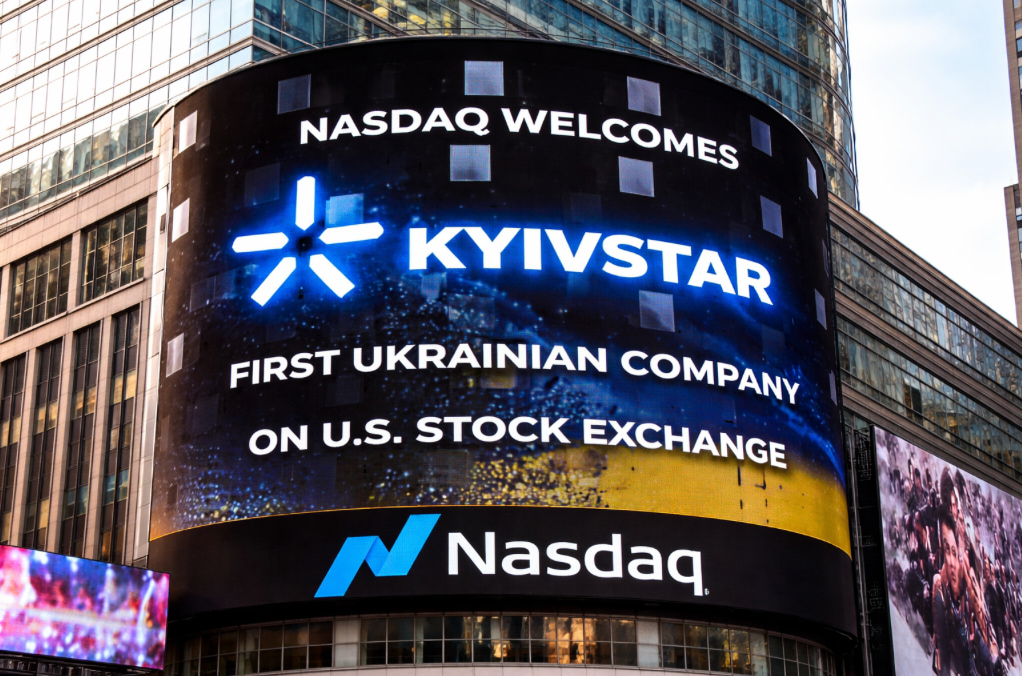
In simple terms, in 2025, the parent company VEON signed a deal with the U.S.-based Cohen Circle Acquisition Corp - a so-called SPAC (a special-purpose acquisition company created to take businesses public). Kyivstar was then merged with this SPAC, which was already listed on the stock exchange. That’s how, in August 2025, the company began trading on Nasdaq under the ticker KYIV.
This marked a historic moment - the first Ukrainian company to be listed on a U.S. stock exchange.
Why Interest in the Company Is Growing
At first glance, it may seem that the risks outweigh everything else - and to some extent, that’s true. However, financial markets rarely think in simple terms like “risky” or “not risky.” They think in terms of balance. In Kyivstar’s case, that balance looks somewhat unusual.
On one hand, it’s a company with a large customer base, predictable demand, and a clear business model. On the other hand, it operates in an environment that is difficult to forecast even a few months ahead.
It’s precisely this combination that creates interest. For some investors, Kyivstar is more than just a telecom company. It represents a way to invest in Ukraine itself - in its recovery, its economy, and its future. At that point, not only logic comes into play, but context as well.
Interestingly, the market’s reaction to Kyivstar’s IPO was fairly restrained. That may be one of the most important signals. Without a sharp surge, there’s no overheating. Without hype, there’s more room for rational analysis. This isn’t a story about jumping in for quick gains. It’s a story that requires time - and perhaps that approach aligns more closely with the very nature of the company.

A Simple Financial Breakdown: What It Looks Like in Practice
When it comes to valuing any company - especially around the time of going public - there comes a point when you have to set the narrative aside and simply look at the numbers. In Kyivstar’s case, they are quite compelling.
Based on the latest available data before the listing (primarily 2024 or the last twelve months leading up to the 2025 deal), the company’s revenue was $919 million, with EBITDA at around $515 million. Put simply, the company retains more than half of its revenue at the operating level. For the telecom sector, that’s a very strong point - one that reflects not only scale, but also efficiency.
This suggests the business generates stable cash flow, giving it the capacity both to invest in growth and to potentially return capital to investors over time. However, things get even more interesting when we shift from “how much it earns” to “what it’s worth.” During its 2025 SPAC listing, the company was valued at approximately $2.2–2.6 billion.
At that point, classic investor logic comes into play. Comparing this valuation to an EBITDA of about $515 million results in an EV/EBITDA multiple of roughly 4–5, which looks quite attractive.
For context, telecom companies typically trade in the 5–8 range, and sometimes higher. This suggests that Kyivstar is either undervalued relative to peers or that investors are pricing in additional risk. Most likely, the truth lies somewhere in between.
The story doesn’t end there. What matters is that the company is not standing still. Forecasts made at the time of the listing pointed to strong momentum in 2025: revenue growth of around 20–23%, and EBITDA growth in the range of 19–22%. More optimistic scenarios suggested growth could reach 24–26%.
For a telecom business, these are genuinely high growth rates - and they shift how the company is perceived. At a certain point, it becomes clear: this is no longer just a stable business that “holds its ground,” but one that continues to grow.
The market’s reaction to the listing is also telling. Unlike many high-profile IPOs where shares surge in the first days, Kyivstar’s debut was much more subdued. On its first trading day in August 2025, the stock actually declined by around 17%, with market capitalization remaining close to $2.6 billion.
At first glance, that may look like a weak start. On the other hand, it suggests the market didn’t overheat, and the price was formed more cautiously. That often creates a healthier foundation for long-term performance.
Another important signal came later. In 2026, the company carried out a follow-on offering at around $10.50 per share, raising approximately $131 million. Notably, demand exceeded supply by about five times. This indicates that institutional investors did not lose interest after the IPO - quite the opposite. They were willing to invest even after the initial listing.
On one hand, there are strong financials, high margins, and a stable business.
On the other hand, a measured market reaction and risks that cannot be ignored.
This is exactly where the real investment decision begins.
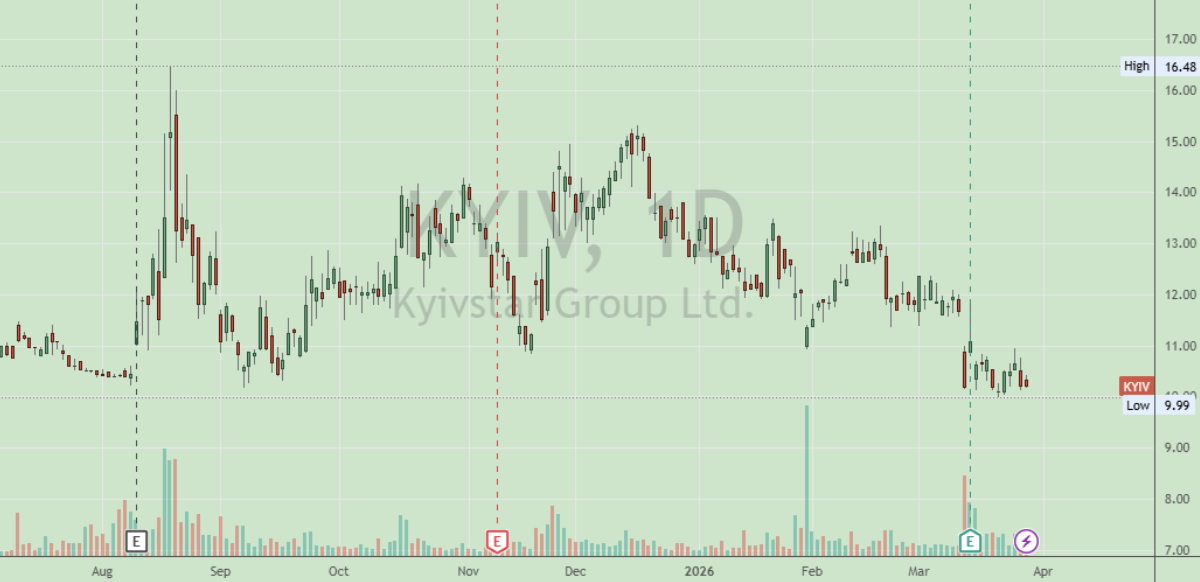
From the price chart perspective, investors found a minimum rational $10 price for a stock that endured a pullback from an initial rally after being combined with a SPAC, two earnings reports, and a share offering, which always dilutes shareholder value and puts pressure on the stock price.
Strength in Predictability
In today’s world, predictability has become an almost underrated asset. Telecommunications is one of the few sectors where it still exists. People may delay purchases, change habits, or cut back on spending - but they don’t give up connectivity. That creates a foundation for stable cash flow, which is exactly what many investors look for, especially in times of uncertainty. In this sense, Kyivstar resembles an “anchor” - not the fastest-moving asset, but a reliable one.
At the same time, it would be misleading to paint too calm a picture. Even the most stable business cannot fully shield itself from external forces. In Kyivstar’s case, those forces are felt particularly strongly. Geopolitics is not just a backdrop - it is part of everyday reality. Infrastructure is not merely an asset, but a constant challenge. Changes can unfold much faster than in normal conditions. All of this means that investing in such a company inevitably involves dealing with uncertainty.
Perhaps the most accurate way to describe Kyivstar is through contrast - and it is precisely this contrast that makes its IPO story so unusual for the financial market.
It is a stable business in an unstable environment.
A predictable model under unpredictable conditions.
An ordinary company operating in an extraordinary reality.
Conclusion
Kyivstar’s IPO is not about hype or quick wins. It’s about something else.
It’s about a company that doesn’t build illusions, but simply keeps operating. A business that doesn’t promise a “revolution,” yet provides something that’s hard to imagine modern life without. It’s also about a market that is trying to evaluate not just the numbers, but the context as well.
Perhaps these are the kinds of stories that matter most today. Because they show not only how a business grows, but how it endures - and continues moving forward.