


Value Investing vs. Growth Investing Explained
Have you ever wondered why two experienced investors can look at the same company and come to completely different conclusions? One investor sees an opportunity because the stock looks undervalued and believes the market has overlooked its true potential. The other ignores it entirely, choosing instead to invest in companies growing rapidly - even if their shares already seem expensive.
Neither investor is necessarily right or wrong. They're simply following two different investment philosophies: value investing and growth investing.
For decades, these two approaches have shaped some of the world's most successful investment portfolios. Legendary investors like Warren Buffett built their careers by identifying businesses trading below their intrinsic value, while others have generated remarkable returns by investing early in innovative, fast-growing companies long before they became market leaders.
So, which strategy is better? The truth is, there isn't a single answer. Both value and growth investing have outperformed at different points in history, and both continue to play an important role in today's financial markets. More importantly, choosing between them isn't just about picking stocks - it's about understanding your own investment goals, risk tolerance, and time horizon.
Whether you're investing for long-term wealth, building your first portfolio, or simply trying to understand why certain stocks outperform others, learning the difference between these two strategies is an important step toward becoming a more informed investor.
In this article, we'll explain what value and growth investing are, explore the key differences between them, discuss the advantages and risks of each approach, and help you understand which strategy - or combination of strategies - may best fit your long-term investment objectives.

What Is Value Investing?
Value investing is built around a simple idea: Buy quality companies when they are trading below what you believe they are actually worth.
Value investors believe that markets are not always perfectly efficient. Sometimes companies become undervalued because of temporary economic challenges, negative news, or broader market sentiment - even though their long-term fundamentals remain strong.
Rather than chasing the fastest-growing businesses, value investors focus on finding companies whose share prices don't fully reflect their intrinsic value. These companies often share several characteristics. They may have stable earnings, strong cash flow, experienced management teams, healthy balance sheets, and long histories of generating profits. Many also pay regular dividends and trade at lower valuation multiples than the broader market.
One of the most famous advocates of value investing is Warren Buffett, whose investment philosophy focuses on buying outstanding businesses at reasonable prices rather than chasing short-term market trends.
Imagine two companies operating in the same industry with similar financial performance. One experiences temporary negative headlines, causing its share price to fall significantly, while its underlying business remains healthy. A value investor may see this as an opportunity to buy a strong company at a discount.
Of course, not every "cheap" stock is a good investment. Sometimes a low share price reflects genuine business problems rather than temporary market pessimism. That's why successful value investing requires patience, careful analysis, and the ability to distinguish between companies that are temporarily undervalued and those facing long-term structural challenges.
What Is Growth Investing?
Growth investing takes a very different approach. Instead of looking for companies that appear inexpensive today, growth investors focus on businesses expected to grow much faster than the overall market in the future.
These companies are often found in industries experiencing rapid innovation, such as technology, artificial intelligence, cloud computing, biotechnology, renewable energy, and digital services. Unlike mature businesses, growth companies frequently reinvest most of their profits to expand operations, develop new products, hire talent, or enter new markets. As a result, they often pay little or no dividends.
Because investors expect these businesses to generate significantly higher earnings in the future, growth stocks usually trade at higher valuations than the average company.
Companies like NVIDIA, Amazon, and Tesla have all been considered classic examples of growth investments at different stages of their development. Growth investing offers the potential for exceptional returns when companies successfully execute their long-term strategies. However, high expectations also create a higher risk.
If revenue growth slows or future earnings fail to meet investor expectations, even excellent companies can experience sharp declines in their share prices. This makes growth investing potentially more volatile than value investing, especially during periods of rising interest rates or economic uncertainty.
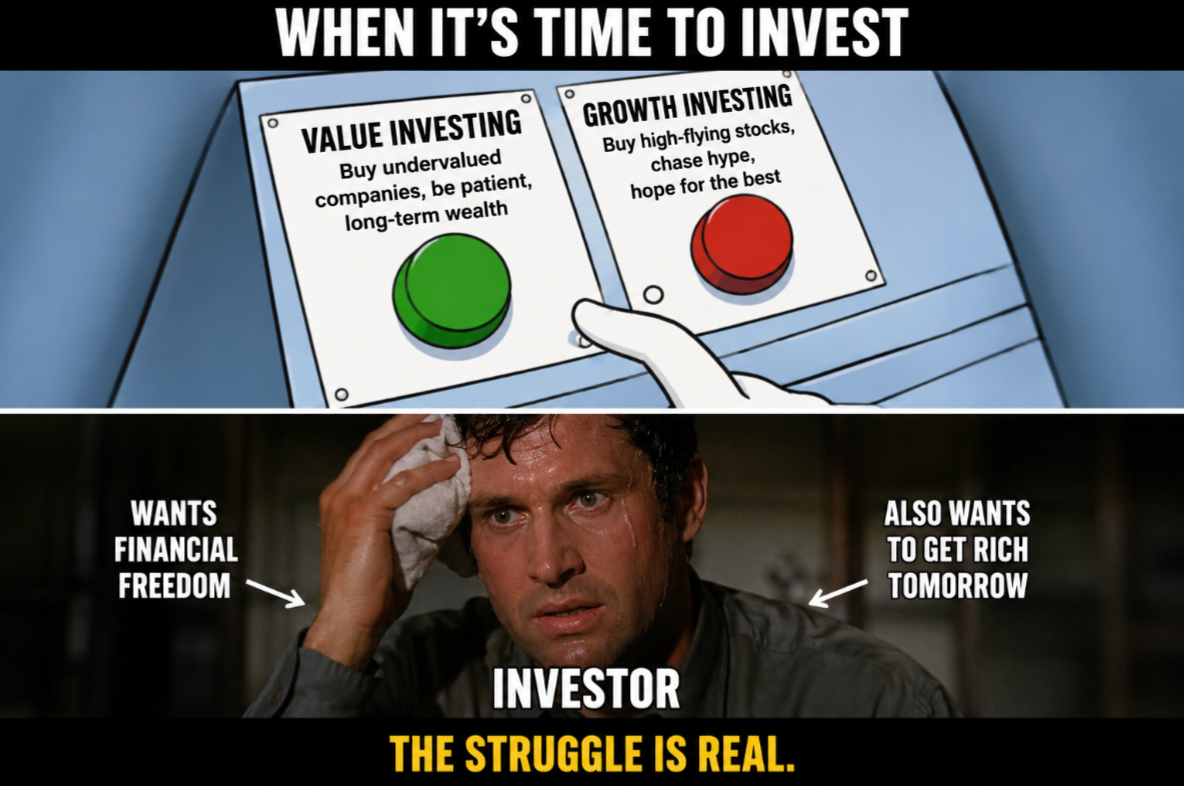
Value vs. Growth Investing: What's the Difference?
Although both strategies aim to generate long-term returns, they rely on fundamentally different ways of identifying investment opportunities.
Perhaps the biggest difference lies in what investors are actually paying for. Value investors are primarily buying today's financial strength. They look at current earnings, assets, cash flow, and valuation. Growth investors, on the other hand, are paying for tomorrow. They believe future innovation, expanding markets, and increasing profits will justify today's higher stock prices.
Neither philosophy is inherently better. They simply reflect different ways of thinking about long-term value creation.
Which Strategy Performs Better?
This is probably the most frequently asked question. Unfortunately, there is no simple answer. The performance of value and growth investing changes over time because financial markets move through different economic cycles.
During periods of strong economic expansion, low interest rates, and rapid technological innovation, growth stocks often outperform. Investors become more willing to pay premium prices for companies capable of delivering exceptional future earnings.
This was particularly evident throughout much of the 2010s, when technology companies dominated global stock market performance. By contrast, periods of higher inflation, rising interest rates, or slower economic growth often create a more favorable environment for value investing. Investors begin placing greater importance on current profitability, stable cash flows, and reasonable valuations.
History has shown that leadership rotates between these two styles. Trying to predict exactly when one strategy will outperform the other is extremely difficult - even for professional investors. This is the same story as with the bull and bear market periods. Instead of trying to time these shifts perfectly, many experienced investors focus on maintaining a diversified portfolio that can perform across different market environments.
Can You Combine Both Approaches?
Many investors assume they must choose between value investing and growth investing. In reality, some of the strongest portfolios combine elements of both. A balanced investment strategy might include:
established companies with consistent earnings and dividend payments
innovative businesses capable of delivering above-average growth
defensive sectors that provide stability during economic uncertainty
emerging industries with long-term expansion potential
Combining value and growth investments can improve diversification while reducing reliance on a single investment style. For example, mature healthcare, consumer goods, or financial companies may provide stability during volatile periods, while technology or artificial intelligence companies offer greater long-term growth opportunities. The objective isn't to predict which strategy will outperform next year. It's to build a portfolio capable of performing through multiple market cycles.
What Investors Should Focus On
Whether you lean toward value investing or growth investing, the most important decision is rarely about labels. Instead, successful investing starts with understanding the business itself. Before buying any stock, consider asking questions such as:
Does the company have a sustainable competitive advantage?
Is revenue growing consistently?
How profitable is the business?
Does management allocate capital effectively?
Is the current valuation justified by future expectations?
How does this investment fit into my overall portfolio?
These questions often provide much more useful insights than simply deciding whether a company is "value" or "growth." Ultimately, both strategies require discipline, research, and patience. Neither offers guaranteed success, but both can become powerful long-term approaches when applied consistently and supported by sound risk management.
Conclusion
The debate between value investing and growth investing has existed for decades - and it will likely continue for decades to come. Each strategy has produced exceptional investors, remarkable long-term returns, and periods of both strong performance and disappointment. Rather than asking which approach is universally better, investors may benefit more from asking which one best matches their financial goals, investment horizon, and personal tolerance for risk.
The reality is that markets are constantly changing. Some years reward companies with stable earnings and attractive valuations, while other years reward innovation, disruption, and rapid expansion.
Understanding both investment styles allows you to adapt more effectively as market conditions evolve while avoiding the temptation to chase whichever strategy happens to be performing best at the moment, because successful investing isn't about finding the "perfect" investment philosophy. It's about building a strategy you understand, believe in, and can confidently follow through every stage of the market cycle.